
Infill Replenishment in Austin
Restore displaced infill to maintain proper drainage, cushioning, and fiber support — critical after Central Texas storm seasons.
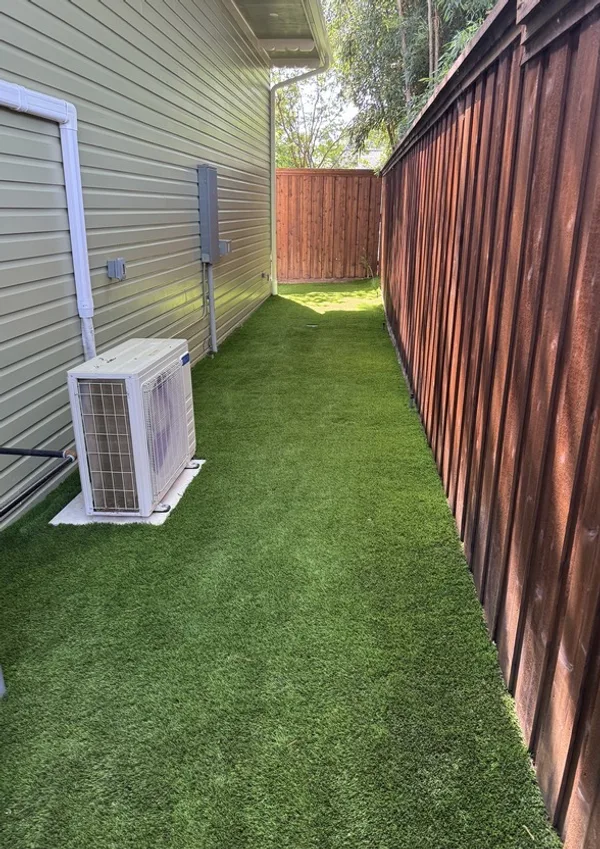
Most artificial turf owners think about their grass in terms of what they can see: fiber color, blade height, surface cleanliness. They almost never think about what's beneath those fibers — and that's exactly why infill problems tend to go unaddressed until they've caused significant damage.
Infill is the granular material packed between your turf's synthetic blades. You can't easily see it, and on a freshly installed yard you probably can't even tell it's there. But infill is the foundation on which every aspect of your turf's performance depends. When infill levels drop — through displacement, compaction, or degradation — drainage suffers, fibers flatten and don't respond to grooming, the surface gets harder and less comfortable, and edge stability decreases. These problems compound over time, turning a recoverable maintenance issue into a premature turf replacement if left unaddressed.
In Austin, infill depletion happens faster than most homeowners expect. The city's combination of severe spring storm events, intense UV exposure, significant pet activity, and high-traffic use creates an environment that depletes and compacts infill at rates well above what moderate-climate turf owners experience. Tejas Turf Cleaning performs infill assessments and replenishment throughout the Greater Austin, serving residential and commercial clients in Austin, Mansfield, Benbrook, and the surrounding communities. Contact us to schedule an assessment.
What Does Turf Infill Actually Do?
Infill performs five critical functions in an artificial turf system. Understanding each one helps clarify why infill maintenance matters.
Blade support is the most visible function. Infill holds synthetic grass fibers upright. Every blade in your turf is rooted at the backing but requires the lateral support of infill material to maintain its upright orientation under load. When infill levels drop below the critical threshold — typically 3/4 to 1 inch from the fiber tips — blades have insufficient support to resist matting pressure. The result is permanent-looking matting that professional reblooming can improve but infill replenishment is needed to fully resolve.
Drainage is the second critical function. A properly infilled turf system drains at rates up to 30 inches per hour — far faster than any rainfall Austin is likely to experience. But as infill compacts, the micro-channels that direct water flow toward the backing perforations close off. Compacted infill can drop drainage rates to 5–10 inches per hour or less, creating pooling after the moderate rains that are common in spring. In an area where a single storm can drop 2–3 inches in an hour, adequate drainage isn't optional.
Cushioning and impact absorption make turf comfortable and safe. The infill layer is what creates the soft, padded feel underfoot that makes synthetic grass pleasant to walk on barefoot. More critically for play areas and athletic surfaces, infill provides the shock absorption that protects joints from impact forces. Depleted infill creates measurably higher impact forces — a real safety concern for children's play surfaces and athletic training areas.
Weight and structural stability prevent the turf system from lifting and shifting. Infill adds approximately 1–2 lbs per square foot to the turf system, which in combination with edge restraints and seam adhesive creates a stable, wind-resistant installation. Severely depleted infill can contribute to edge lifting, seam separation, and surface buckling — all of which are expensive to repair.
Temperature regulation is a function specific to certain infill types. Standard silica sand retains significant heat under direct sun — a limitation in Austin's summers. Specialty infills, including acrylic-coated sand and certain organic alternatives, reflect more solar radiation and can meaningfully reduce surface temperatures on hot Texas afternoons.
How to Tell If Your Artificial Turf Needs More Infill
Several signs indicate infill depletion that's reached a level requiring professional attention.
Visible turf backing is the most obvious — when you can see the black or gray backing material through the grass blades, particularly in high-traffic areas, infill levels have dropped significantly in that zone. This is common in the center of dog runs and along primary foot traffic paths.
Uneven surface height — areas where the turf visibly sits at different heights in different zones — indicates infill migration. Infill naturally displaces toward the perimeter under repeated foot traffic. A yard with a consistent depression in the center and higher buildup near the edges is a classic infill migration pattern.
Water pooling after rain that persists for more than 30–60 minutes in a correctly installed turf system usually indicates infill compaction affecting drainage. If your turf pooled fine for the first two years and now pools after moderate rain, infill compaction is the likely culprit.
Hard surface feel underfoot — particularly in high-use areas that previously felt cushioned — indicates that the infill has compacted below functional levels. The surface becomes firmer as infill particles pack together, eliminating the air space between particles that creates cushioning.
Fibers that won't stand up after professional reblooming — that look improved immediately after service but return to flat within a few days — usually indicate inadequate infill support rather than a fiber issue. Grooming lifts the fibers, but without infill to support them they return to flat under the first foot traffic.
Turf age of 3+ years without infill service is itself a reason for an assessment. Even without visible symptoms, infill compaction is occurring in every turf installation over time. A professional depth measurement at 3-year intervals gives you accurate information about your infill status.
Types of Turf Infill — Which Is Right for Your Property?
Silica sand is the most common infill in the Austin area market — clean, angular, kiln-dried sand that provides excellent drainage and blade support at the lowest cost. It's the right choice for most residential applications without significant pet use and for property owners prioritizing cost-effectiveness. Standard silica sand does retain heat, which is a meaningful limitation in Austin summers — surface temperatures on silica sand-infilled turf will be higher than specialty alternatives.
Zeolite (ZeoFill) is our recommendation for any installation with regular pet use. Zeolite is a naturally occurring volcanic mineral with an incredibly porous structure that actively absorbs and neutralizes ammonia — the primary odor compound in pet urine. Zeolite-infilled turf produces dramatically less odor between professional pet odor treatments than silica-infilled turf, because the infill itself is doing continuous odor work. It costs more than silica sand but delivers measurable value for pet-heavy applications.
Antimicrobial-coated infill (typically silica sand coated with Microban or similar technology) inhibits bacterial growth in the infill layer. This is particularly relevant for commercial pet facilities, daycares, and any high-traffic installation where sanitation is a priority. The antimicrobial coating doesn't eliminate the need for professional cleaning, but it meaningfully slows bacterial colonization between visits.
Crumb rubber was the dominant infill in older installations and is less commonly specified in new installations today. Existing crumb rubber infill that's 5+ years old often shows UV degradation and compression that reduces its effective cushioning. When replenishing crumb rubber installations, we typically recommend transitioning to silica or zeolite rather than adding more rubber.
Acrylic-coated sand — including TempZone and similar specialty products — offers meaningfully lower surface temperatures than standard silica by reflecting rather than absorbing solar radiation. For properties in sun-exposed locations or families with young children who play barefoot, the temperature reduction is worth the premium. Austin's intense summer sun makes this a more relevant consideration here than in most markets.
How We Replenish Your Turf Infill
Infill replenishment begins with a thorough measurement and assessment. We take depth readings at a minimum of 12–16 points across the turf area to create an accurate map of infill distribution. This tells us exactly where infill is deficient, where migration has created excess, and the total volume of infill needed to restore appropriate levels throughout. We determine the infill type that's most appropriate for your specific use case and discuss options with you before ordering material.
Surface preparation matters before adding new infill. Adding material over loose debris can trap it below the new infill. We clean and rebloom the surface first — which is why infill replenishment works well alongside a cleaning visit.
Application uses specialized spreading equipment that achieves even distribution across the turf surface. Hand-spreading or improvised methods create infill concentration inconsistencies that cause the same drainage and support problems we're trying to solve. Our equipment delivers consistent depth coverage in measured passes.
After spreading, we use our power broom to work the new infill down between the turf blades, integrating it with any existing material and settling it to the appropriate depth. This mechanical integration step is critical — infill that sits on top of fiber tips rather than between fibers at the proper depth doesn't provide blade support or drainage function.
Post-application measurement at the same grid points as our initial assessment confirms that target depth has been achieved across all zones. We don't consider the job complete until measurement confirms it — not just visual inspection.
Why Austin Properties Lose Infill Faster
Austin experiences more than 80 thunderstorm days per year — far above the national average. Those storms produce intense, concentrated rainfall events that can move significant infill if any drainage issues exist. Central Texas's occasional hail events, which occur several times per year, physically displace infill through impact. And the high-wind events that accompany Austin's severe weather season can move light infill materials when turf edge retention has any gaps.
The freeze-thaw cycles that Austin experiences — multiple times per winter in most years — cause infill expansion and contraction that gradually loosens the packing structure. The dramatic temperature swings of a Central Texas winter (40°F in the morning, 75°F in the afternoon isn't unusual) subject infill to repeated thermal stress cycles that a more stable climate wouldn't produce.
Pet activity is among the fastest causes of infill migration. A large dog running and turning at full speed kicks infill toward the perimeter with every stride. A yard with two or more active large dogs can see meaningful infill migration within a single year of installation.
Pricing, FAQs, and Next Steps
Infill replenishment is available as an add-on to any cleaning service, covering labor, equipment, and standard silica sand. Specialty infill materials (zeolite, antimicrobial-coated sand, acrylic-coated specialty products) carry material surcharges that vary by product and quantity. Request a quote on our pricing page, or contact us for a free on-site assessment.
How often does infill need replenishment? For typical residential use without pets: every 3–4 years for a professional assessment, with replenishment as needed. Pet owners and high-traffic areas: annual assessment, replenishment approximately every 2 years. Commercial and athletic surfaces: annual assessment and replenishment as indicated by measurement.
What's the difference between silica sand and zeolite? Both provide blade support and drainage. Zeolite additionally absorbs and neutralizes ammonia from pet urine, dramatically reducing odor between professional cleaning visits. For any installation with regular pet use, zeolite is worth the premium — the odor reduction is meaningful and consistent.
Can I add infill myself? Basic silica sand top-dressing over small areas is technically possible as a DIY project. The challenges are achieving consistent distribution without proper spreading equipment, integrating new infill with existing without power brushing, and avoiding the common error of adding infill to contaminated turf that should be cleaned first. Professional replenishment consistently delivers better depth uniformity and results.
Does adding infill make the turf feel softer? If your turf has hardened because infill has compacted or depleted, replenishment will restore the cushioning. Specialty infill like rubber-crumb alternatives or purpose-built cushioning systems provide measurably softer results than standard silica. We discuss options based on your use case — a children's play area has different priorities than a dog run.
Ready to assess your infill? We're serving Austin, Round Rock, Cedar Park, and the surrounding Greater Austin communities. Fill out our online form to schedule your free assessment today.
Service Overview
Deep cleans start at $339
Includes:
- Infill level assessment
- Silica or antimicrobial sand
- Even distribution
- Drainage restoration
- Blade support optimization
Our technicians follow standards set by the Synthetic Turf Council — the industry's leading authority on synthetic turf care.
Infill Replenishment Near You
We serve all of Greater Austin and the Hill Country. Click your city for local pricing and availability.
Other Services You May Need
Most Austin homeowners pair infill replenishment with one of these — bundle and save with our recurring plans.
Remove embedded bacteria, pet dander, and Central Texas limestone dust — plus power-brush flattened fibers back to life. Reblooming included in every deep clean.
Neutralize stubborn pet urine odors amplified by the Texas heat with our oxygen-powered treatment process.
Patch burns, re-seam separations, fix pet-damaged spots, and restore storm-torn or sun-warped artificial turf back to a seamless, like-new surface.