Pet Odor & Urine Removal in Austin
Neutralize stubborn pet urine odors amplified by the Texas heat with our oxygen-powered treatment process.
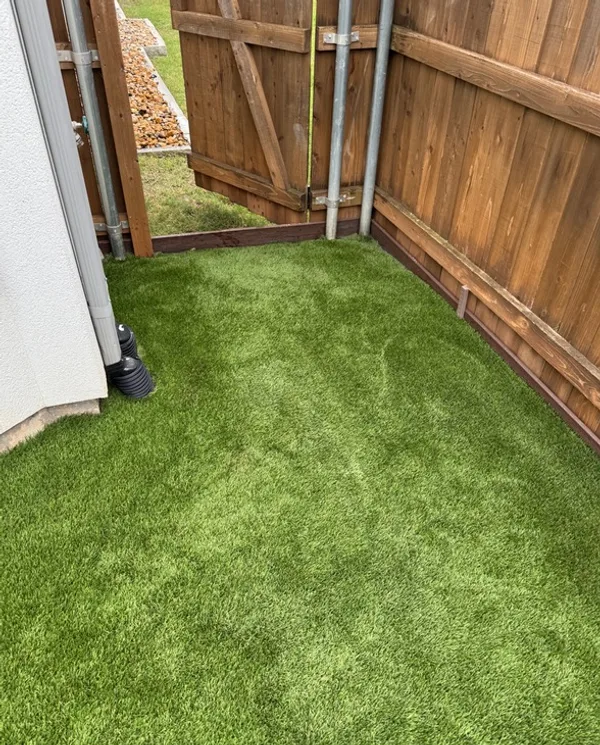
You installed artificial turf partly because of your dogs. No muddy paws, no brown patches, a yard that looks good year-round without constant watering. But now there's a smell — especially in summer, especially after rain — that makes the backyard almost unbearable. You've tried the garden hose, the baking soda, the vinegar rinse, the spray from the pet store. The smell comes back every time, sometimes stronger than before.
This is the most common complaint we hear from Austin pet owners with artificial turf. And the reason nothing you've tried has worked permanently isn't that your turf is ruined — it's that none of those approaches address what's actually causing the odor. The problem isn't on the surface of your turf. It's deep inside the infill layer, where uric acid crystals have bonded to the granular material and the turf backing itself, and where no consumer product can reach them at the concentration needed to break them down.
Tejas Turf Cleaning uses professional oxygen-powered treatment specifically engineered to chemically break down uric acid deposits — not mask them, not dilute them, not temporarily suppress them. We serve residential pet owners throughout Keller, Southlake, Colleyville, and across the Austin area. Get a free quote to see what professional treatment costs for your specific yard.
Why Does Your Artificial Turf Smell Like Dog Urine?
Understanding why the smell won't go away with rinsing requires a brief science lesson — and it's the kind of content that actually helps you make a good decision about your turf.
When a dog urinates on artificial turf, the liquid flows down through the synthetic fibers and into the infill layer — the granular material (typically silica sand or zeolite) between the blades. Some of it drains through the backing perforations. But uric acid — the organic compound responsible for the sharp, ammonia-like odor — is not water-soluble. It doesn't drain out. Instead, it crystallizes and bonds to infill particles and the turf backing surface as the water evaporates.
Those uric acid crystals are the source of your odor problem. When they're dry, they're largely odorless. But the moment they're rehydrated — by rain, by irrigation, by morning dew, or even by the high humidity common in Central Texas summer mornings (often 70%+ before 10 a.m.) — they release ammonia gas. That's the smell: concentrated ammonia from reactivated uric acid crystals throughout your infill.
Austin's climate makes this dramatically worse than in cooler regions. The city averages 97 days per year above 90°F, including 17 or more days above 100°F. At those temperatures, uric acid crystallization happens within hours of a urination event rather than days. And Central Texas's weather pattern — intense heat followed by sudden thunderstorms — doesn't help. A heavy rain event doesn't flush the problem; it reactivates every crystal simultaneously, washes the surface deposits deeper into the infill where they re-crystallize, and then the returning heat drives a new wave of offgassing.
Over time, urine deposits can leave persistent odors even between pet use events. Where contamination reaches the backing or base, a turf sweep alone cannot remove it; we assess the area and recommend the appropriate treatment or infill work.
Newer Austin subdivisions like Mueller, Steiner Ranch, and Circle C, where homes have large south- and west-facing yards with minimal shade, tend to see the worst crystallization rates because their turf gets maximum direct sun exposure throughout the day.
How We Eliminate Pet Odor From Artificial Turf — Not Just Mask It
The word "eliminate" gets used casually in marketing. We use it specifically: our process oxidizes uric acid into odorless compounds. The chemistry doesn't mask — it destroys.
We begin with a thorough assessment and odor mapping. With professional detection methods — and years of experience reading turf contamination patterns — we identify the highest-concentration areas, which are often not where you expect them. Dogs develop preferred spots and corridors, and the worst contamination typically concentrates in specific 4–6 sq ft zones rather than being uniformly distributed. Mapping these zones lets us concentrate treatment resources where they're most needed.
Pre-treatment and surface preparation comes next. We remove any solid waste, clear surface debris, and apply an initial controlled flush. This step activates and partially surfaces crystallized deposits before the treatment application, improving penetration depth.
Then comes the core of the treatment: professional-grade oxygenated application. Our oxygen-powered solution is formulated at concentrations significantly higher than any consumer product, and applied using equipment that drives it into the full depth of the infill layer — not just the surface. The oxidation chemistry attacks the full spectrum of pet waste contamination — protein-based waste, crystallized uric acid, and fatty compounds alike — breaking each down at the molecular level rather than covering it up.
We then observe mandatory dwell time — typically 20–45 minutes depending on contamination severity. This is the step that DIY treatments almost always skip or rush, and it's the most critical part of the entire process. Oxidative breakdown of uric acid is a chemical reaction that takes time. No amount of additional product compensates for insufficient dwell time.
After dwell, we use a suctioning turf sweep to pick up loosened surface debris, then groom the treated area. The treatment addresses odors; the sweep is not a deep liquid extractor.
We finish with a neutralization and protective finishing treatment — a second, lower-concentration application that neutralizes any residual ammonia compounds and leaves a protective finish in the infill that slows new odor buildup between professional visits. 100% non-toxic, pet-safe immediately after drying.
Why Austin's Climate Makes Pet Odor Treatment Essential
This isn't generic information that applies to turf owners everywhere — it's specific to what Austin pet owners deal with. Austin averages 97 days per year above 90°F, with peak odor complaints clustering in June through September when heat reactivation of uric acid is most intense. Morning humidity in Austin during summer frequently exceeds 70%, creating warm-moist conditions where odor-causing bacteria proliferate rapidly.
The seasonal pattern matters too. Austin's thunderstorm season (April through October) cycles through heat-and-bake followed by sudden heavy rain followed by return to heat. Each rain event reactivates all the existing crystals simultaneously, producing the intense odor spikes that Austin pet owners describe — the yard smells fine in a dry week, then terrible the day after the first storm. Without professional treatment that actually eliminates the crystals, this cycle repeats indefinitely.
The practical upshot: a Austin dog owner who delays professional treatment through one summer is dealing with a contamination problem in September that is meaningfully harder to address than the same problem in April. The crystallization deepens, the bacterial biofilms establish more thoroughly, and the infill compacts around the deposits. Treatment still works — but it takes more of it, and may require multiple visits for severely contaminated installations.
Is Professional Pet Odor Treatment Right for You?
One small dog, occasional use: With diligent regular rinsing after each use, you may manage adequately with annual professional treatment. But quarterly visits will keep your yard in consistently better condition and prevent the gradual build-up that makes even a single-dog yard difficult to address after 2–3 years.
Multiple dogs or large breeds with frequent use: Professional odor treatment is not optional — it's essential for maintaining a usable outdoor space. Monthly treatment is the realistic expectation for yards with 3+ dogs or heavy daily use. Quarterly is the minimum for 2-dog households.
Dedicated dog runs: High-concentration, repetitive-use areas are our most challenging and most rewarding jobs. A well-maintained dog run with monthly professional service is a completely usable, genuinely fresh-smelling space. A neglected dog run after 18 months is a nearly unusable odor problem. The gap between those two outcomes is professional maintenance.
Doggy daycares, boarding facilities, and veterinary clinics: High-traffic turf benefits from recurring cleaning on a scheduled program. We offer commercial maintenance contracts with priority scheduling and volume pricing for facilities throughout Greater Austin.
Rental properties: If you're a landlord with artificial turf at a pet-allowed rental, the turf is very likely in worse condition than you realize after a long-term tenant. We've restored severely compromised turf to rentable condition many times — typically far less expensive than turf replacement. We can assess and advise on realistic outcomes before you commit.
Properties being sold: Pet odor on artificial turf can genuinely impact home sale negotiations in the Austin market. We've helped homeowners restore turf before listing, transforming what was a visible negative into a positive selling point. Treatment timing matters — contact us as early in the process as possible for best results.
DIY Odor Remedies vs. Professional Treatment
We're going to be honest about DIY here, because the last thing we want is clients who tried DIY, gave up thinking their turf couldn't be saved, and pulled it out unnecessarily.
Vinegar rinse: Acetic acid (vinegar) temporarily neutralizes some surface ammonia compounds through acid-base chemistry. It has zero effect on the crystallized uric acid deposits inside the infill. The smell returns within days because the source wasn't touched. Repeated vinegar applications can also accelerate degradation of the adhesive bonding the turf backing.
Baking soda: Absorbs some surface odor temporarily. Zero effect on sub-surface uric acid crystals. The residue can also clog drainage perforations over time if used repeatedly.
Commercial pet turf sprays: Most are fragrance-based masking agents. Some contain active cleaning agents, but at concentrations far below professional formulations — effective for very fresh, light deposits, but completely unable to address established crystalline contamination. They work the first few times, then stop producing noticeable results because the fresh deposits have been handled but the accumulated contamination hasn't.
Garden hose rinsing: Valuable for immediate dilution of fresh deposits — do this every time your dog uses the turf if you want to slow the problem. But rinsing alone may not resolve established odor; ask us about targeted treatment.
Regular rinsing combined with quarterly professional treatment is the right approach. We're not suggesting you stop rinsing — that regular maintenance genuinely helps between professional visits. But the professional visit is what actually addresses the infill-level contamination that rinsing can't reach.
How Much Does Pet Odor Removal Cost in Austin?
Pet odor and urine removal is available as an add-on to any deep clean — a single visit that combines deep cleaning, reblooming, and oxygen-powered odor treatment. Deep cleans start at $339, and we'll quote your exact price based on turf size, condition, and services. Severely contaminated installations with years of unaddressed buildup may require 2–3 treatment sessions spaced 2–4 weeks apart to fully eliminate the problem.
Recurring Monthly plans — our most popular option for pet owners — include per-visit member savings and priority scheduling. Request a free quote on our pricing page. Free assessments are available for commercial facilities and any residential installation where the scope is unclear.
Frequently Asked Questions — Pet Odor Removal
How quickly will the odor be gone? For typical residential installations with moderate contamination, the odor will be significantly reduced or eliminated within 24–48 hours after treatment as the treatment completes its reaction and the turf fully dries. Severely contaminated installations may show significant improvement after the first visit with full elimination requiring a follow-up treatment. We'll give you a realistic expectation after our initial assessment.
Is the treatment safe for my dogs? Completely. Our cleaning products are non-toxic, contain no harsh chemicals, bleach, or fragrances, and are certified safe for pet contact after drying — typically 20–30 minutes on a warm day. We'd never apply anything to a surface your dogs are going to be on that we wouldn't be comfortable with ourselves.
How often do I need pet odor treatment? For most single-dog residential yards in Austin: quarterly. For multiple dogs, large breeds, or high-concentration dog runs: monthly. For commercial pet facilities: monthly is the standard. We'll make a specific recommendation based on your situation during the initial visit.
Can you completely eliminate years of urine buildup? In most cases, yes — though severely contaminated installations may require multiple treatment sessions. The determining factor is how deeply the uric acid has penetrated and whether the turf backing has been compromised. We'll assess honestly and tell you what to expect before we start.
Will the smell come back? After professional treatment, odor won't return unless new contamination accumulates. With regular quarterly professional maintenance, most clients keep their turf consistently fresh-smelling year-round. A yard that smells fine after treatment and then develops odor again hasn't "relapsed" — it's accumulated new deposits from continued pet use, which is exactly why ongoing maintenance matters.
Do you treat commercial pet facilities? Yes, and commercial pet facilities are a significant part of our business. We offer structured commercial maintenance contracts with priority scheduling, documentation for health compliance, and volume pricing. Contact us to discuss the specific requirements for your facility.
Service Overview
Deep cleans start at $339
Includes:
- Urine crystal breakdown
- Deep oxygenated flush
- Pet-safe deodorizer
- Odor neutralization (not masking)
- Preventative barrier
Our technicians follow standards set by the Synthetic Turf Council — the industry's leading authority on synthetic turf care.
Pet Odor & Urine Removal Near You
We serve all of Greater Austin and the Hill Country. Click your city for local pricing and availability.
Other Services You May Need
Most Austin homeowners pair pet odor & urine removal with one of these — bundle and save with our recurring plans.
Remove embedded bacteria, pet dander, and Central Texas limestone dust — plus power-brush flattened fibers back to life. Reblooming included in every deep clean.
Restore displaced infill to maintain proper drainage, cushioning, and fiber support — critical after Central Texas storm seasons.
Patch burns, re-seam separations, fix pet-damaged spots, and restore storm-torn or sun-warped artificial turf back to a seamless, like-new surface.